| Jesus is No Myth | ||||||||||||||||||||||||||||||||||||||||||||||||||||||||||
| Dedicated to refuting
the idea that the Biblical Jesus Christ was not a historical character.
------------------------------------------------------------ ARTICLES
ARTICLES FOR CHRISTIANS
EVIDENCES in PDF
CONTACT For a free copy of the booklet Jesus is No Myth send an e-mail with your name and address to Jesus is No Myth. [Your name and address will be used only to address the package containing the booklet. It will not be used for any other purpose.]
|
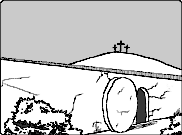
![]() The Empty Tomb The whole of Christianity rests upon the historical fact of the resurrection of Jesus of Nazareth from the dead. The importance of the Resurrection cannot be overstated. It is the foundation of Christianity. As the Apostle Paul wrote to the Corinthians, I Cor. 15:14 “...if Christ has not been raised, then our preaching is vain, your faith also is vain. 15 Moreover we are even found to be false witnesses of God, because we witnessed against God that He raised Christ, whom He did not raise, if in fact the dead are not raised. 16 For if the dead are not raised, not even Christ has been raised; 17 and if Christ has not been raised, your faith is worthless; you are still in your sins. 18 Then those also who have fallen asleep in Christ have perished. 19 If we have hoped in Christ in this life only, we are of all men most to be pitied..” If the resurrection did not occur then:
Yet, many churchmen today deny outright the possibility of a physical resurrection. They may say that ‘the bones of Jesus rest in the soil of Palestine,’ or that Jesus rose in the proclamation of the gospel, and the disciples came to believe that he had survived through death, and that they could thus preach that he was alive. Still others may put the change in the disciples. These would say that the disciples had known Jesus to live in true freedom, and afterward they entered that experience for themselves. This meant that they came to see that Jesus was not dead but a living influence. For the most part these religious leaders are influenced by Humanism, the philosophy that is the outgrowth of materialistic naturalism. The humanist tends to follow the 19th Century Rationalist hypothesis as described by Henry Morison, “Driven by the immense strength and cogency of the case for the empty tomb, the German Rationalist Venturini put forward the suggestion that Christ did not actually die upon the Cross, but fainted, and that in the cool temperature of the grave he recovered and subsequently appeared to the disciples.” 1 This was an effort to provide—in their words—a “rational explanation” for the resurrection and the growth of Christianity. It became known as the “swoon theory.” This story has appeared in similar form in other places, and in the work of other writers. But the most startling characteristic of the first Christian preaching is its emphasis on the resurrection. The first preachers were sure that Christ had risen, and sure, in consequence, that believers would in due course rise also. This marked them out as different from all the other teachers of the ancient world. Other religions tell of resurrections, but none of them is like that of Christ. They are mostly mythological tales connected with the change of the seasons and the annual miracle of spring. The Gospels tell of an individual who truly died in the full physical sense of the word “dead,” but overcame death by rising again in bodily form in which he appeared to credible witnesses. Since Christ’s resurrection bears no resemblance to anything in paganism, the attitude of Christians to their own resurrection, the corollary of their Lord’s, is radically different from anything in the heathen world. Nothing is more characteristic of heathen religion—even the best thought of the day—than its hopelessness in the face of death. Clearly the resurrection is of first importance for the Christian faith. And it is important because He did rise from the dead, a historical fact confirmed by the evidence. 1 Morison, F., Who Moved the Stone, p. 96.
|
|||||||||||||||||||||||||||||||||||||||||||||||||||||||||